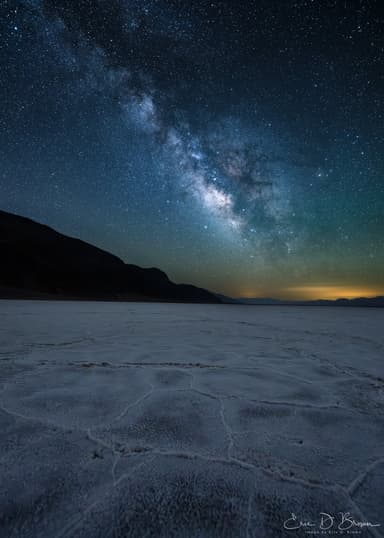
How to Plan the Full Milky Way Arch Shot
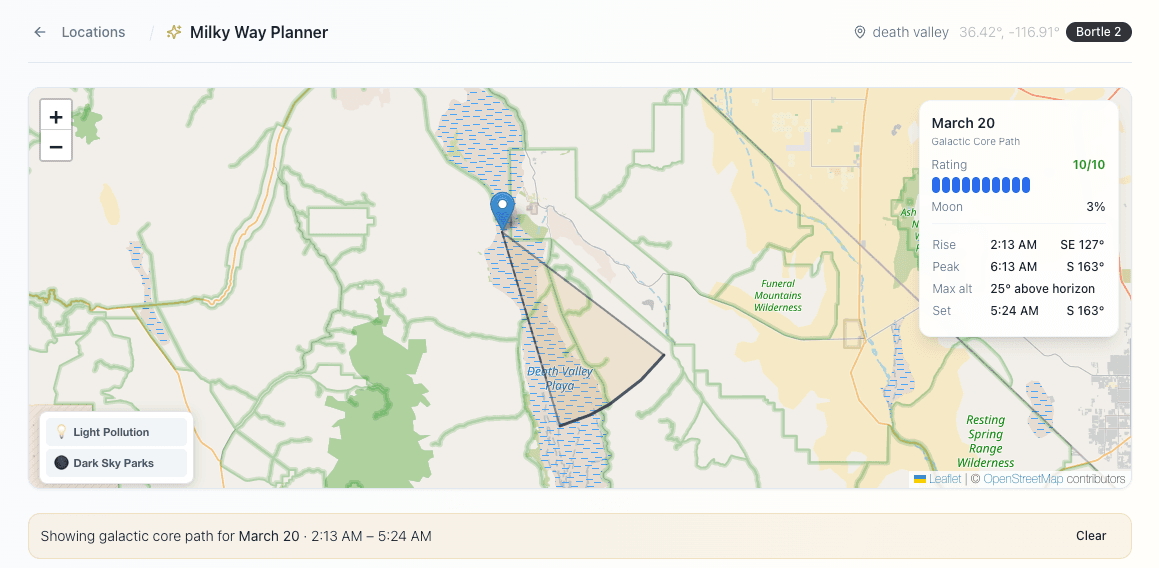
The full Milky Way arch from horizon to horizon is a narrow planning target. Here's the timing, latitude, and location requirements that make it work.
The full Milky Way arch is one of the more specific planning challenges in astrophotography. Most photographers encounter the summer Milky Way first, the core high in the south, the plane tilted toward vertical. That's a different shot from the full horizontal arch, where the galactic plane runs low across your sky from one horizon to the other. Figuring out when that's actually possible is where most of the planning work lives.
This shot doesn't happen at every new moon during Milky Way season. It happens in a specific window, at a specific time of night, and only if your location, your latitude, and your horizons cooperate. If you're trying to figure out when to put it on the calendar, this is what you're planning for.

What is the full Milky Way arch?
The full Milky Way arch is what you see when the galactic plane runs nearly horizontal across your sky from one horizon to the other. The bright core anchors one end, the fainter galactic anticenter (out near Auriga and Gemini) anchors the other, and the plane sweeps low across the sky in between.
This horizontal version of the arch is only possible during a narrow window each year. By June and July at northern latitudes, the core has climbed high in the south and the plane has tilted toward vertical, still beautiful but not the horizon-to-horizon stretch.
The timing window
In the Northern Hemisphere, this is a late-winter and early-spring shot. February through April is the prime window, and you're shooting in the pre-dawn hours, roughly 3 to 5 AM depending on the date.
Here's what's happening in the sky during those hours. The galactic core rises in the southeast a few hours before sunrise. The anticenter, which has been higher in the sky earlier in the night, has rotated around to the northwest. For a stretch before the sky starts to lighten, both ends of the arch sit above the horizon at roughly similar elevations, and the plane connecting them runs low across your sky.
By April, the core is already higher and rising earlier. By May, the arch has tilted toward vertical and the horizontal sweep is gone. The window closes fast.
If you want this shot, you're getting up at an unreasonable hour to do it.
Why latitude matters more than most people realize
Most planning advice treats latitude as a footnote. For the full Milky Way arch, it's the whole game.
The galactic core sits at a declination of about –29°. The anticenter is at roughly +22°. For both to clear the horizon at the same time, your latitude has to fall in a specific range.
- Below 35°N (Texas, the Gulf Coast, Florida). The core climbs higher in the sky than it does for shooters further north, but the anticenter sits lower. You can shoot the arch, but the geometry is less generous and the window is narrower than you might expect.
- 35–45°N (Utah, Colorado, the Pacific Northwest, the Northeast). This is the sweet spot. Both ends of the arch get enough elevation to clear most foreground obstructions, and the pre-dawn window stretches further into spring.
- 45–50°N (Northern Plains, Southern Canada). The core stays low and the window compresses. You can still get the shot, but you need a clean southern horizon and good atmospheric transparency, because the core is fighting more air.
- Above 50°N. The core barely makes it above the horizon during true darkness. By the time it's high enough, the sky is already getting light. The full horizontal arch isn't really achievable.
Location requirements
The full arch needs two clear horizons. Southeast for the core, northwest for the anticenter. Most photography spots have one or the other, and finding a location with both clear horizons is harder than it sounds.
The southern horizon is the more important of the two. The galactic core is the brightest, most detailed part of the Milky Way, and it's also the part most sensitive to light pollution and atmospheric haze. If there's a city glow in the south, or mountains, or a treeline, that end of the arch is going to suffer. You want Bortle 1 to 3 in that direction if you can get it. Bortle 4 will work for the rest of the arch but it's going to crush the southern detail.
The northern horizon is more forgiving. The anticenter is fainter overall and lacks the dust lanes and color that make the core a light pollution problem. Bortle 3 or 4 in the north is workable.
The best terrain for this is high desert (Utah, Eastern California, parts of Nevada), elevated plains (eastern Montana, parts of Wyoming and New Mexico), or anywhere with a real horizon and minimal sky glow in the south. Coastal locations are usually rougher because of marine layer haze, but elevated coastal sites can work.
If your normal shooting spot has a great southern horizon but trees to the north, you might still get most of the arch. Just know what you're trading.
Using MWP to find your window
The planning problem comes down to overlapping a few things. A new moon window. The pre-dawn hours when the arch is horizontal. Weather you can't predict more than a week out. Your own ability to be somewhere dark at 4 AM.
This is what milkywayplanner.com is built for. The galactic core arc data shows you when the core is rising and where it'll be at any given time on any date. Pair that with the moon phase calendar, pick the new moon windows in February, March, and April, and you can see at a glance which mornings put the core in the right position for a horizontal arch.
I'd plan a shot like this two or three months out. Pick the new moon window. Pick the morning where the core is at its lowest pre-dawn altitude (lower core means more horizontal arch). Confirm your location's southern and northern horizons. Then watch the weather as the date gets closer.
The symmetrical moment
There's one more thing worth thinking about, and it's something I want to add to MWP at some point.
The arch isn't equally photogenic at every moment of the night. There's a specific point in time when the galactic plane is most evenly balanced across the sky, when the core and the anticenter are roughly equidistant from the meridian, and the arch is at its most symmetrical. It's calculable from local sidereal time and your latitude, but right now you have to figure it out by eye.
I want to surface this in the planner. Show the user not just when the core is up, but when the arch is at its most symmetrical for a given location and date. That's the moment that makes the shot.
For now, the workaround is to look at the arc data and find the time when the core's elevation roughly matches the anticenter's elevation on the opposite side of the sky. If you're shooting the full arch, that's the moment to time your panorama around.