Planning a 12-Day Photography Trip in Milky Way Planner
A real walkthrough of planning a 12-day Milky Way photography trip across Utah, Arizona, and New Mexico using the Milky Way Planner premium trip planner. Four stops, eleven nights, all in dark skies.
Tomorrow I'm leaving for a 12-day Milky Way photography trip across Utah, Arizona, and New Mexico. Four stops, eleven nights, every one of them under dark skies. I'm writing this the day before I leave, while everything is fresh in my head and the planning is fully in front of me.
This is exactly how I planned it.
A note up front: the trip planner is a Milky Way Planner premium feature. There's no free version of it. Everything in this post needs a paid account. I'm showing it because I genuinely use it. This is a walkthrough of a real trip, not a product demo.
The shape of the trip
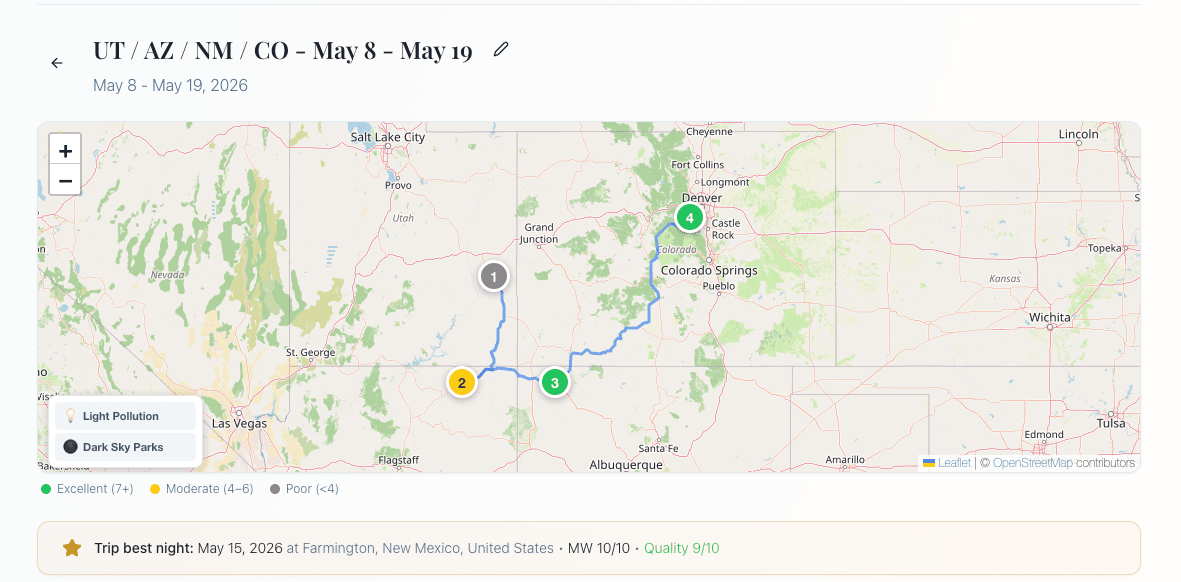
Twelve days, four overnight stops:
- May 8 evening, Moab UT. Single shoot night.
- May 9 to 12, Goulding's Lodge, Kayenta AZ. Monument Valley adjacent. Three evenings.
- May 12 to 18, Farmington NM. Six nights, including a workshop at the Nightscaper Conference.
- May 18, Jefferson County CO. One overnight on the way home.
- May 19. Back in Denver.
The trip is timed to the Milky Way galactic core season (May through October in the northern hemisphere) and around a moon-down window so I can shoot late nights without lunar interference. Every stop has dark skies, which is what makes the southwest such a good destination this time of year.
Starting from a blank map
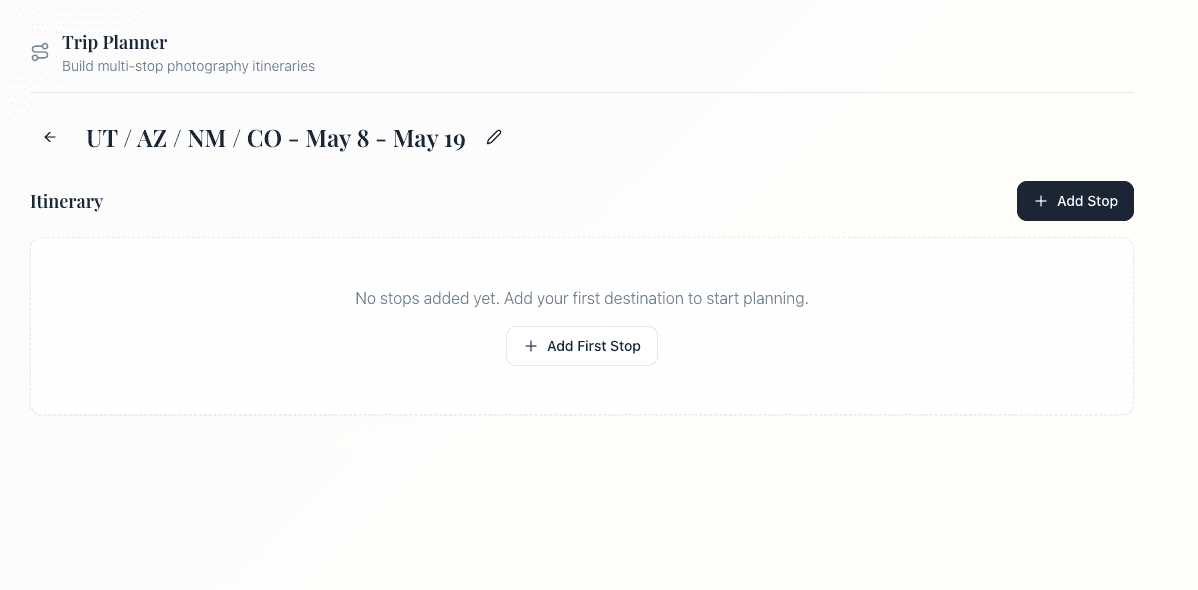
When you open the trip planner, you get an empty map and a left-hand panel ready to receive stops. Each stop becomes a row in your itinerary, with dates, location, and the data layers you care about: light pollution, Milky Way visibility for those dates, weather forecast where available.
The pattern is to build the trip in trip order, one stop at a time. Each addition recomputes the rest of the plan around it.
Stop 1: Moab, May 8
Side by side, before and after adding Moab to the trip:
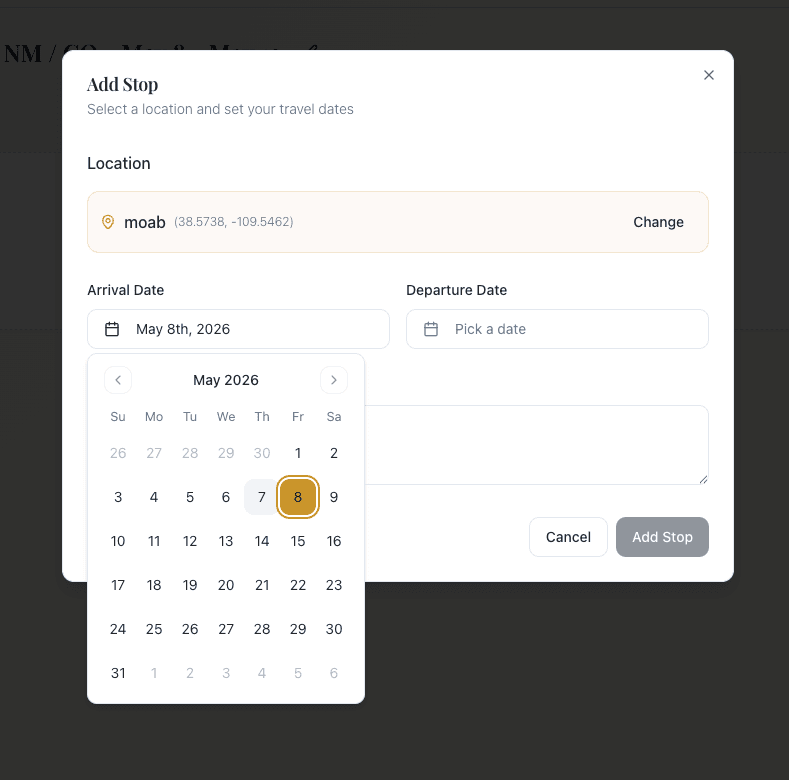
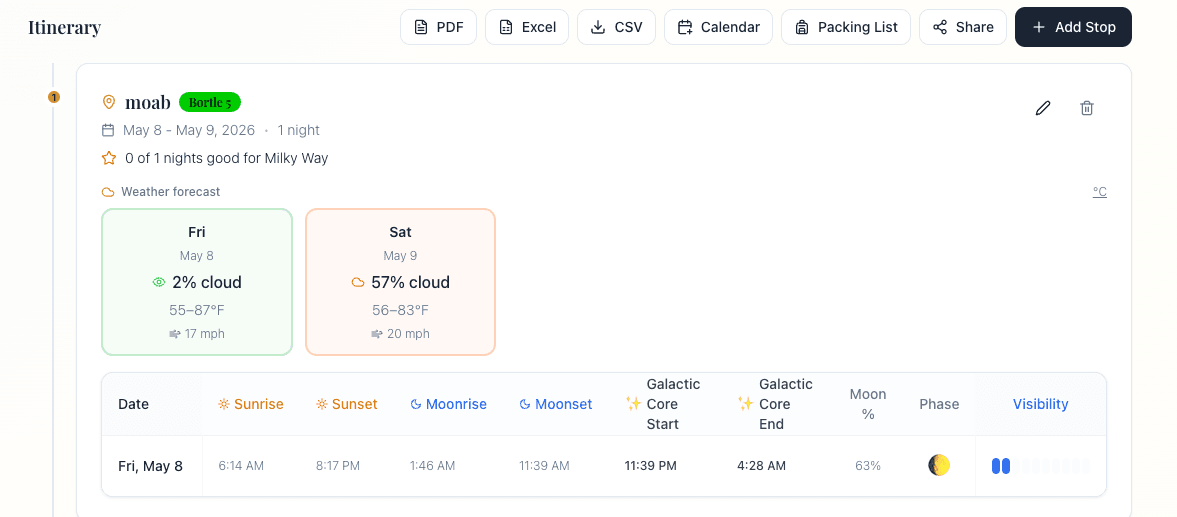
Drop the pin, set the date, and the planner pulls in the relevant data for that location and that night. The "after" view shows the light pollution rating, the Milky Way visibility window, and the location's place on the building itinerary.
Moab is a single-night stop for me, mostly because I want to start the trip with a familiar location and an easy first shoot. The galactic core rises late but is well up by the early morning hours, which fits a Friday-night-into-Saturday-morning shoot.
Stop 2: Kayenta, May 9 to 12
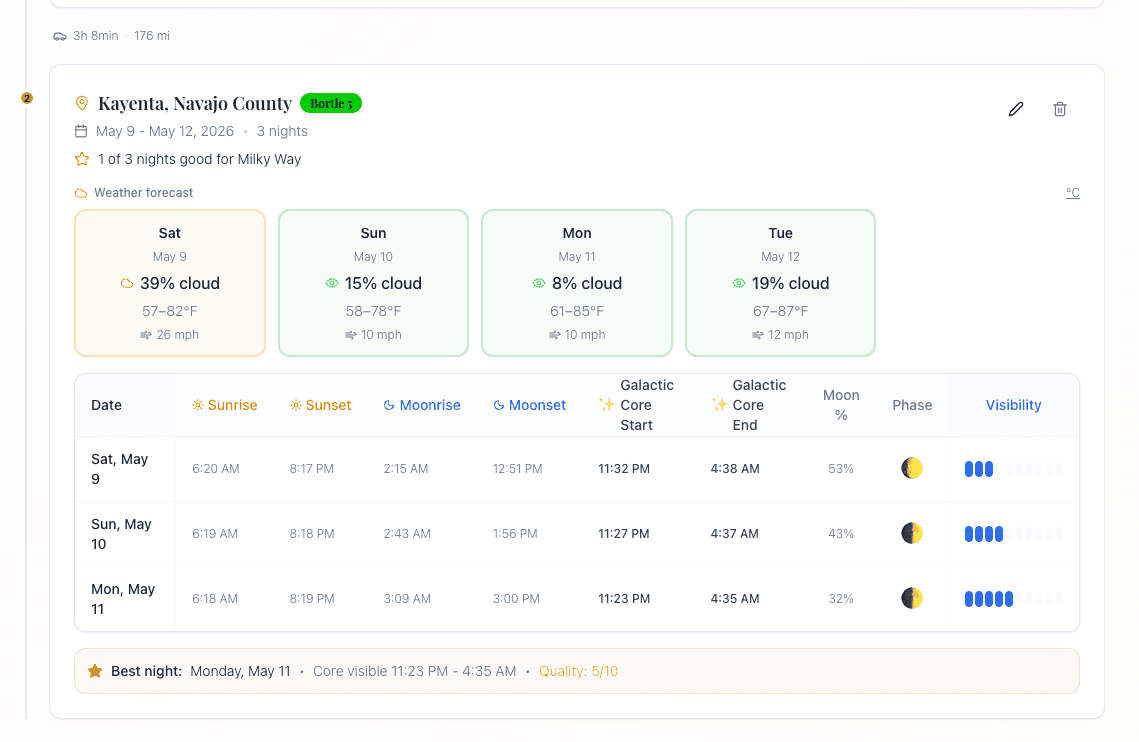
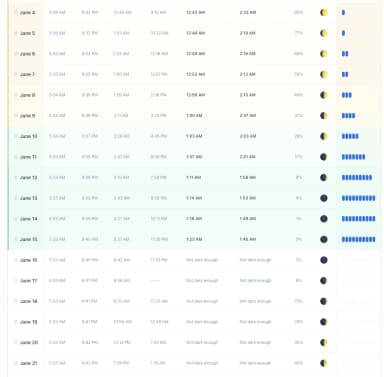
Three nights at Goulding's Lodge, which sits right at the entrance to Monument Valley. Dark skies and distinctive foregrounds for hundreds of miles in any direction. The trip planner shows me how each of the three evenings looks: galactic core position, moon altitude, sunset and astronomical twilight times.
Multi-night stops are where the trip planner earns its keep. Without it, I'd be doing the same lookup three times and trying to keep them straight in a notes file.
Stop 3: Farmington, May 12 to 18
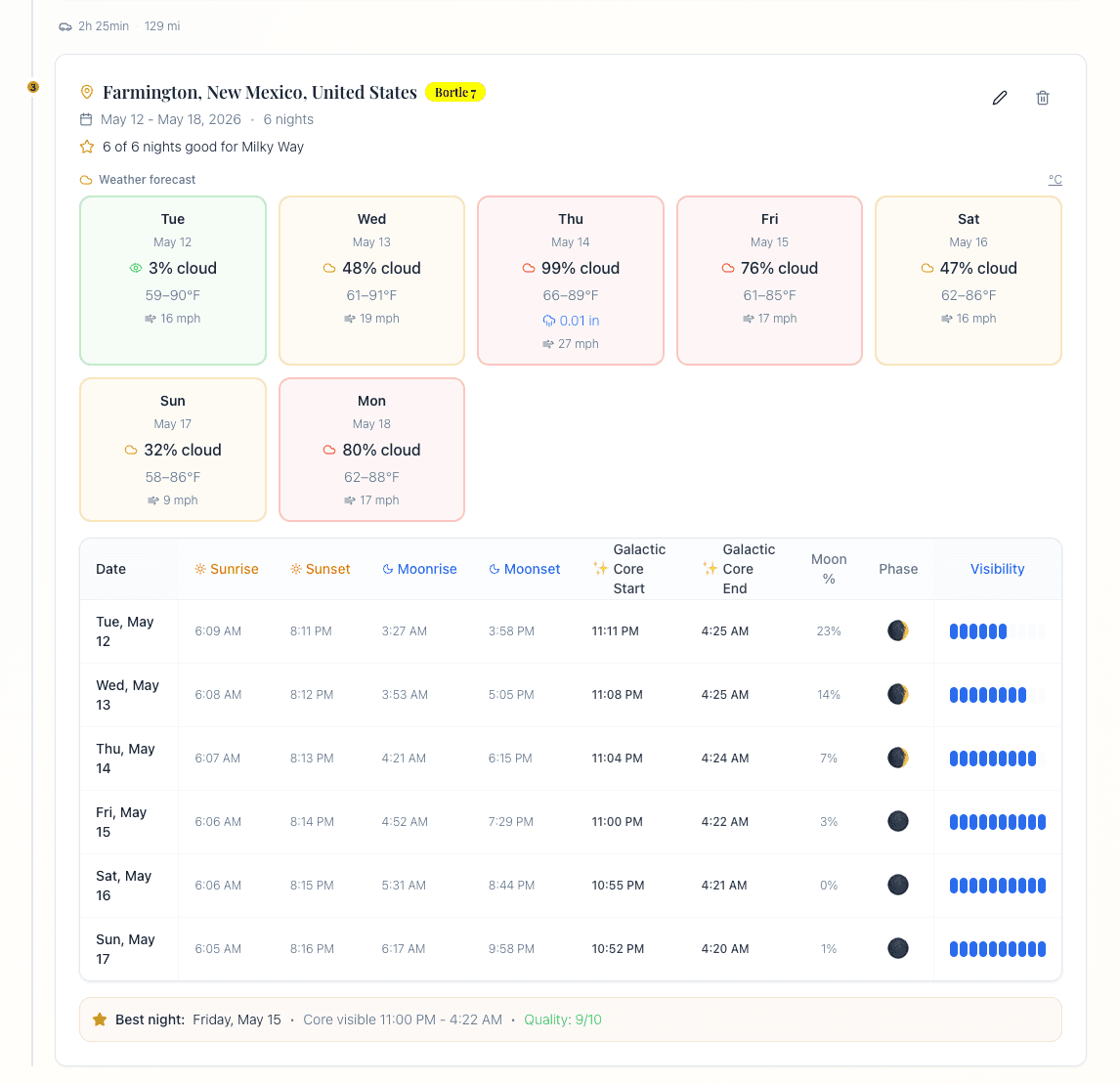
The longest leg of the trip. Six nights based out of Farmington, attending a workshop at the Nightscaper Conference plus solo shooting time in the Bisti / De-Na-Zin Wilderness and the Chaco Culture area. The Nightscaper Conference is one of the larger nightscape photography events in the country, and Farmington's proximity to multiple iconic dark-sky locations makes it a natural base.
Six evenings of shooting potential, plus workshop programming during the day. The plan view shows me which evenings are weather-favored and which moon position helps which composition.
Stop 4: Jefferson County, May 18
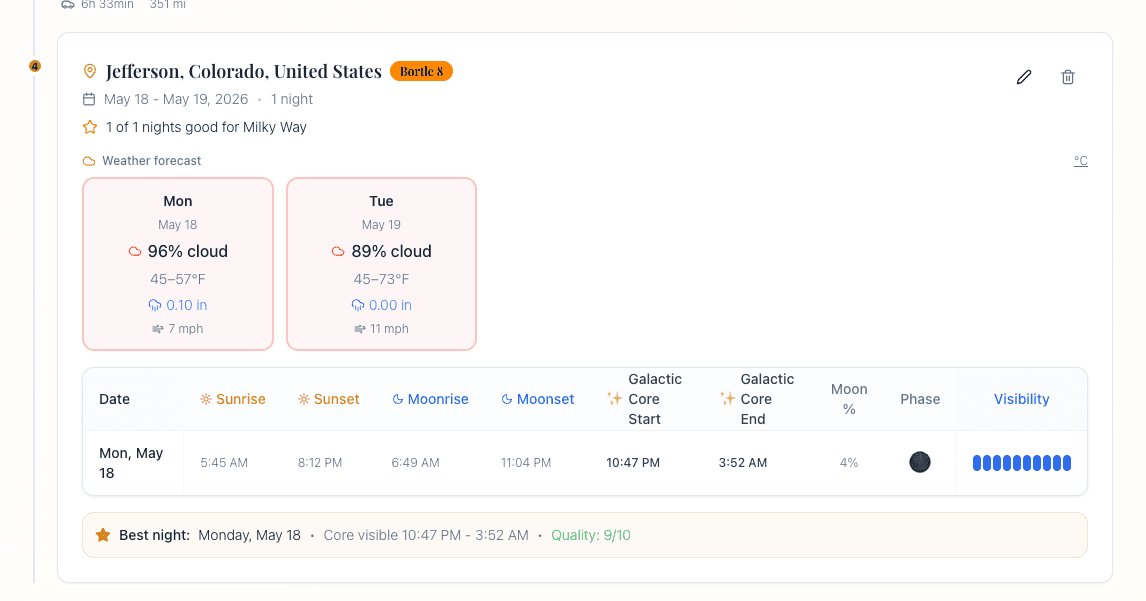
A single overnight on the drive back to Denver. Even a one-night stop gets planned. There's a small but real value in knowing the conditions for any shoot opportunity that comes up during a long drive home.
What the plan does for you
A trip plan in Milky Way Planner isn't just a saved map. It produces several outputs:
PDF export. The full itinerary as a printable document. Useful for travel companions who don't want to log in to anything, or for the glove compartment during long drives where cell signal isn't a given.
Excel and CSV exports. Same data in spreadsheet form. Good if you want to merge the trip into a master calendar of shoots, hand it to a workshop coordinator, or do your own analysis on shoot windows.
Add to calendar. Each night, each stop, the Milky Way visibility window for that location, and the trip link itself can be pushed to your calendar. So when you're standing in Farmington on May 14 and your phone reminds you the galactic core peaks in two hours, that's the plan working in the background.
Packing list. A general astrophotography packing reference. Not personalized to your gear, but a solid baseline of what you wouldn't want to find out you forgot when you're four hours from the nearest store.
Shareable link. Anyone you give the link to can see the full plan without an account. Useful for showing workshop leaders, friends meeting you on part of the trip, or readers of a blog post like this one.
The actual plan
If you want to see this exact trip in Milky Way Planner, here it is:
milkywayplanner.com/trip/ut-az-nm-co-may-8-may-19-oyas
That link will show you the four stops, the dates, the route, and the data layers I planned around. You can examine it the same way I'd hand a paper itinerary to someone planning a similar trip.
Closing
My trip starts tomorrow. The plan above is what I'll be living out of for the next twelve days. I'll write something when I'm back about how the shots lined up with the plan.