Scout Now, Shoot Later: Location Planning Before Milky Way Season
The photographers who get great Milky Way shots plan in two phases. Here's how to use Milky Way Planner to find your windows, and what to do with that information before you ever show up at night.
I'd never shot in Park County, Colorado before. Last spring I spent most of a day just driving around, looking around, trying to figure out if there was anything worth coming back for.
Park County sits about two hours from home. Close enough for a quick trip if conditions are right, far enough that I don't want to show up without a plan. So I went down to take a look. No gear except a camera and no specific location in mind.
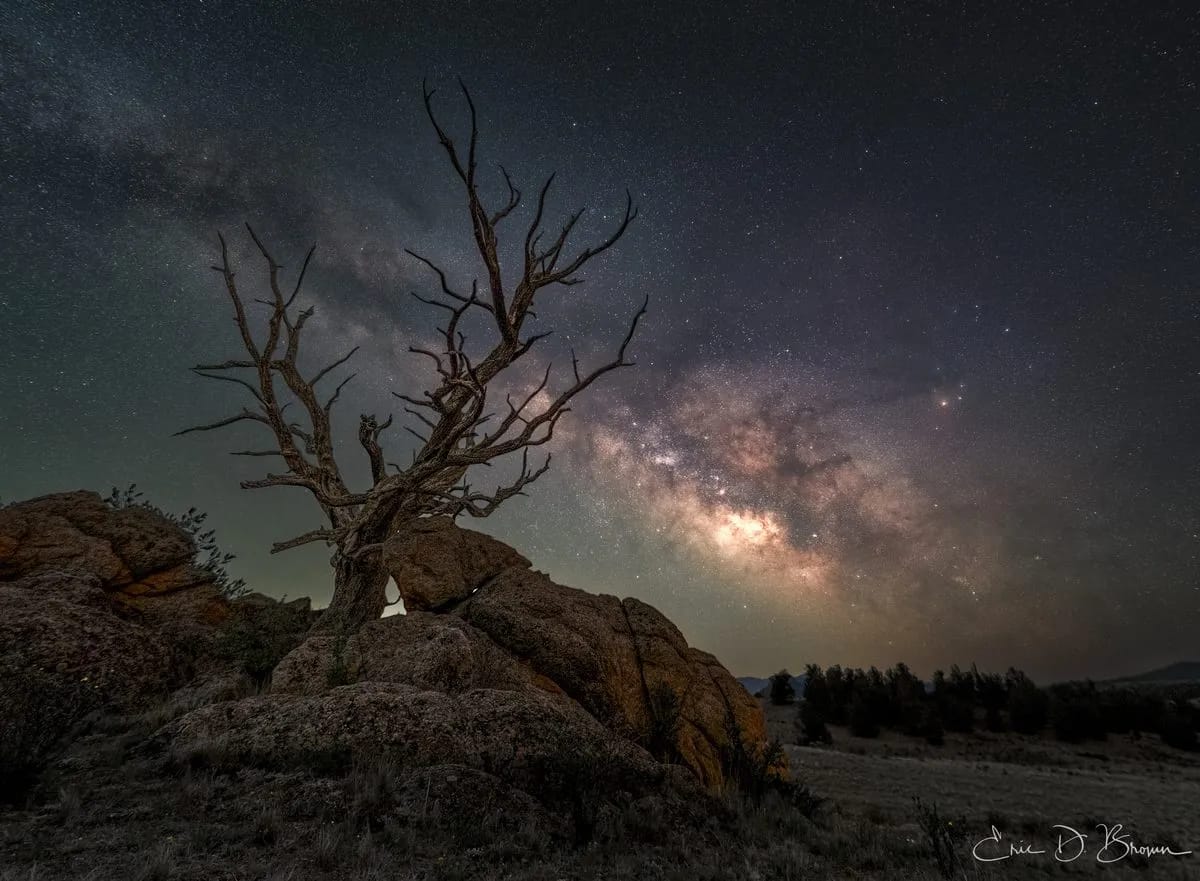
I came across a small hill with a cluster of rocks and an old gnarled tree on top. I saw it from about half a mile away and knew I needed to check it out. I parked the Jeep, walked up, and spent the next thirty minutes working around that hillside figuring out where I wanted to stand, what the frame would look like, where the Milky Way would come up relative to that tree.
I used PhotoPills to model the core position and timing for the dates I was thinking about. By the time I hiked back down to the Jeep, I knew exactly where I'd set the tripod, what time I needed to be there, and what direction I'd be facing.
The Two-Phase Planning Problem
Most Milky Way photographers think about planning as a single thing: pick a date, go shoot. Photographers who get good shots regularly think about it in two phases.
Phase one is strategic. You're answering the question: when are my best opportunities this season, and roughly where do I want to be? This is where Milky Way Planner fits in. At this point, you're not worrying about foreground yet but just finding the best days and times for your shooting windows.
Phase two is tactical. You go to your location during the day and figure out the specifics. Where exactly will you stand? What's your foreground? What direction does the core come from at the time you're planning to be there? This is where PhotoPills and Planit Pro come in.
A lot of photographers do phase two, but they do it right before sunset on the same night they're shooting. That's not enough time. You're rushed, the light is going, and you haven't thought through the composition. The scouting that actually pays off happens days or weeks before the shoot, when there's no pressure and you can take your time.
Phase One: Finding Your Window with Milky Way Planner
Here's how the Park County trip came together.
I knew I wanted to shoot in May. The core is well positioned by late May, and I had a window of time that could work. I pulled up milkywayplanner.com and checked May for my area.
If I were planning this out today, looking at Milky Way Planner for May in Park County, Colorado, this is what I would see:
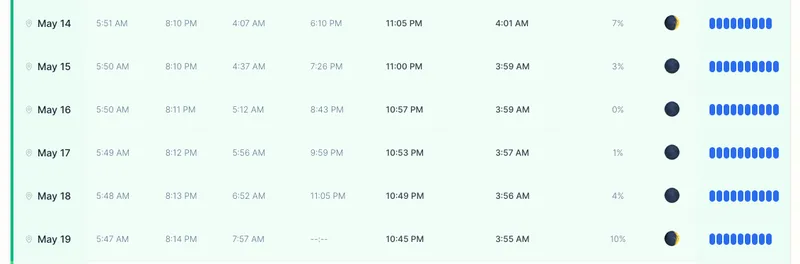
The best visibility days are mid-month around the new moon window, core rising at 11:05 PM, plenty of dark sky time before astronomical twilight. Six consecutive nights where conditions would be close to ideal.
This is how I use Milky Way Planner for every trip. I'm not planning the shot yet. I'm finding the window. Once I know the best nights, I can work backwards: when should I scout? What do I need to figure out before I show up at 10 PM with a tripod?
You can check any location on milkywayplanner.com to see when the core is up, when the moon is down, and which nights in a given month give you the best combination of both. It takes a few minutes and tells you whether the timing is worth building a trip around.
Phase Two: Going to Look
Finding your window tells you when. It doesn't tell you where to stand.
That's what scouting is for. The goal isn't to take photos but to understand the terrain before you need to work it in the dark.
A few things I look for when scouting a new location:
Foreground. What's worth shooting? Rock formations, trees, structures, water. The core is going to arc across the same sky it always does. The foreground is what you're actually deciding.
Sightlines. Where is south? The galactic core is always in the southern sky in the Northern Hemisphere. If mountains are blocking the south, that's a problem. A wide-open view to the south is your canvas.
Footing and access. Where can you actually stand with a tripod? Is the terrain workable in the dark? I've scouted spots that looked great from 50 feet away and turned out to be unworkable because of drop-offs or dense brush.
The specific composition. Once I find a foreground element I like, I walk around it trying to find the exact spot where the frame works. That hillside in Park County took me thirty minutes to figure out, and I still made a small adjustment when I came back at night.
When you find your spot, mark it. GPS pin, photo of the area, notes in your phone or whatever works so you can build your library of locations to return to when the timing lines up.
The Field Tools
I use PhotoPills on-site to model exactly where the core will be at the time I'm planning to shoot. It shows an AR overlay of where the Milky Way will be at any date and time. Planit Pro does the same, though I'm more of a PhotoPills person myself. These are tactical field tools that answer the question: given where I'm standing right now, what will I be looking at at 11 PM on May 16?
Milky Way Planner doesn't do augmented reality overlays or real-time sky positions. What it does is help you find the nights worth planning around, months ahead, before you've committed to a date or driven anywhere. That's a different job, and it's one PhotoPills isn't really built for.
Use both. Milky Way Planner to find your windows. PhotoPills or Planit Pro when you're standing in a field trying to figure out where to aim.
The Payoff
The night I went back to that hillside in Park County, I already knew everything I needed to know. I knew how to get there, where to park, and where to set up. The core came up exactly where I expected, behind the tree, just past the rocks.
The photo at the top of this post is from that night. I wasn't guessing at the composition or hoping the core would clear the tree in time. I already knew it would. That's what preparation actually buys you: not a guarantee, but the ability to be present when it happens instead of scrambling to figure out where to stand.