How Latitude Changes Everything About Your Milky Way Season
Your latitude determines your Milky Way season length, nightly shooting window, and how high the galactic core rises. Learn what to expect at your location.
That tutorial you watched was shot in Arizona. You live in Oregon.
I see this problem constantly. A photographer follows the instructions exactly, checks the moon phase, drives to a dark location. The galactic core barely peeks above the horizon while the guy in the YouTube video has it soaring overhead. They assume they did something wrong.
They didn't. The tutorial just never mentioned that the advice was specific to a southern latitude.
Most Milky Way content assumes a location somewhere in the desert Southwest without saying so. Writers shoot from places where the galactic core climbs high and the shooting season stretches for months. They say "the Milky Way is visible from March through October" as if that applies everywhere. It doesn't apply in Minnesota. It doesn't apply in Washington. It barely applies in Colorado.
If you photograph from the Northern Hemisphere, your latitude determines three things: how long your season lasts, how many hours you get each night, and how high the core rises. Once you understand these differences, you can stop wasting trips and start planning around your actual conditions.
Why Latitude Matters
The galactic core appears in the southern sky for anyone in the Northern Hemisphere. The center of our galaxy sits at a declination of about -29 degrees, which means from anywhere north of the equator, you look south to see it.
The further north you go, the lower that southern sky sits relative to your horizon. The further south you go, the higher it climbs.
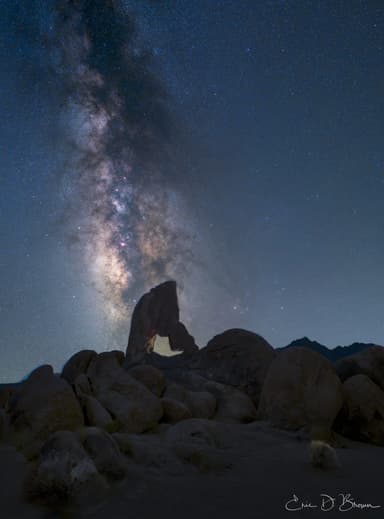
A photographer in Phoenix watches the galactic core arc high across the sky. A photographer in Seattle sees it hug the southern horizon, never getting far above the trees. Same galaxy, same night, completely different view.
This affects when you can shoot, how long you can shoot, and what compositions work.
What Defines "Season"
Before looking at season length, we need to define what counts as shooting season.
I define it as the months when the galactic core rises above the horizon during astronomical darkness. Astronomical darkness means the sun is at least 18 degrees below the horizon. Before that point, sky glow from twilight competes with the Milky Way.
At northern latitudes in summer, astronomical darkness may last only a few hours or may not occur at all. This compresses the usable season even when the core is technically above the horizon.
The season ranges below assume you want the core visible during true darkness for at least a couple hours.
Season Length by Latitude
Latitude compresses or expands your shooting months. Our lesson on Milky Way photography by season breaks down what changes from spring through fall.
Southern US (25°N to 35°N): Texas, Arizona, New Mexico. The season runs from late February into October. Eight months of shooting opportunities.
Mid latitudes (35°N to 45°N): Most of the continental US. March through September. You lose roughly a month on each end compared to southern locations.
Northern latitudes (45°N to 55°N): Pacific Northwest, northern tier states, southern Canada. April through August is more realistic. The core doesn't rise during dark hours outside this window.
Above 55°N: This covers northern Alberta, most of Alaska, and the northern territories. The season shrinks to weeks rather than months. June and July put the galactic core above the horizon, but astronomical darkness may not occur at all during those months. You end up with a narrow window in late April/May and again in August/September when you get both a visible core and actual darkness.
Nightly Shooting Window
Beyond the season, latitude affects how many hours you get on any given night.
Southern locations get longer windows because darkness arrives sooner after sunset and the core spends more time at useful altitudes. On a good night in Big Bend, you might have five or six hours with the core visible in dark skies.
Northern locations get squeezed from both ends. Twilight lingers longer in summer, eating into your window. And the core spends less time above the horizon overall. Your actual shooting time might shrink to two or three hours on that same calendar date.
This matters when you're deciding whether a four-hour drive to a dark site makes sense.
How High the Core Gets
This catches most people off guard.
At 30°N latitude (southern Arizona, southern Texas), the galactic core can reach 50 to 60 degrees of altitude at its peak. That's more than halfway up the sky. Vertical compositions with the Milky Way overhead become possible.
At 40°N latitude (Denver, Indianapolis, Philadelphia), the core maxes out around 35 to 45 degrees of altitude. Still decent, but noticeably lower. Your vertical shots become diagonal shots.
At 47°N latitude (Seattle, Minneapolis, Portland), the core barely clears 25 to 30 degrees. It never gets far above the horizon.
At 50°N and higher, twenty degrees of altitude might be as good as it gets.
Note on Canada: Most of Canada's population lives below 50°N. Toronto sits at 43°N, Vancouver at 49°N, Montreal at 45°N. If you're in a major Canadian city, you're probably in the 45-50°N range, not above it.
Why altitude matters for image quality:
Higher altitude means you shoot through less atmosphere. Light traveling straight up passes through a thinner column of air than light coming in at a low angle. Less atmosphere means less haze, less light pollution scatter, and less atmospheric distortion.
When the core sits at 20 degrees altitude, you're shooting through roughly three times as much atmosphere as when it's at 60 degrees. Any light pollution on the southern horizon becomes a bigger problem. Haze that wouldn't show at higher angles becomes obvious near the horizon.
The composition trade-off:
Lower core positions put the Milky Way closer to your foreground. This makes it easier to include landscape elements without pointing your camera straight up. Horizontal compositions with the arc of the Milky Way stretching across the frame work well at northern latitudes. If you want the classic vertical core shot rising from a foreground element, you need either a southern latitude or a wide-angle lens and some distortion.
Core Orientation Changes
The galactic core doesn't just move up and down. It rotates throughout the night and changes orientation across the season.
Early in the season (March-April in southern locations), the core appears more horizontal when it first rises, lying along the horizon. As summer progresses, it rises more vertically. By August and September, you're back to more horizontal orientations in the evening.
This affects composition planning. A location that works for a vertical core shot in June might produce a diagonal or horizontal core in April. Check the orientation for your specific date, not just the altitude.
Planning Trips to Different Latitudes
Heading South
If you normally shoot from a northern location and travel south, expect changes.
The core reaches higher altitudes than you're used to. Compositions that were impossible at home become available. Bring a wider lens or plan for vertical panoramas.
Darkness arrives earlier relative to the core's position. You might start shooting right after twilight instead of waiting hours for the core to rise.
The core's orientation may differ from what you see at home on the same date. Check your planning app for the specific location.
Heading North
The core stays lower. Scout for compositions that work with a Milky Way closer to the horizon. South-facing views with clear horizons become more important. Trees, hills, or buildings to your south will block more of the core than they would at home.
Plan around shorter windows. You may only have a few hours, so arrive early and have your shot ready.
At extreme northern latitudes in summer, twilight may never fully end. True astronomical darkness might not happen at all in June or July above 55°N. Check whether darkness actually occurs on your planned dates.
Latitude Reference for Common Destinations
- Big Bend, TX: 29°N
- Joshua Tree, CA: 34°N
- Death Valley, CA: 36°N
- Moab, UT: 38°N
- Denver, CO: 40°N
- Cherry Springs, PA: 41°N
- Toronto, ON: 43°N
- Yellowstone, WY: 44°N
- Acadia, ME: 44°N
- Montreal, QC: 45°N
- Seattle, WA: 47°N
- Vancouver, BC: 49°N
- Banff, AB: 51°N
- Fairbanks, AK: 65°N
When you see a photo from one of these locations, you can estimate how different your conditions will be at home.
Practical Takeaways
Stop comparing your results to photos shot 1,000 miles south. That photographer has different conditions.
Check your latitude when following any tutorial. If the instructor says "the core will be at 45 degrees," that might not apply where you live.
Use planning tools that show conditions at your actual coordinates. Generic advice based on southern-latitude assumptions wastes your time. MilkyWayPlanner.com lets you check exactly what conditions look like at your specific location before you commit to a shoot.
Consider latitude when booking travel. A trip to Big Bend in late February can work. That same trip to Yellowstone in late February would be pointless for Milky Way photography. If you are planning a trip to a tropical destination, latitude is just one of the factors to consider.
Wrapping Up
Latitude determines your season length, your nightly window, and how high the galactic core climbs in your sky. Northern photographers deal with compressed seasons and lower core altitudes. Southern photographers get extended seasons and high arcs.
Each has trade-offs. Lower core positions make horizontal compositions with foreground elements easier. Higher core positions give you vertical shots and cleaner image quality through less atmosphere.
Once you understand how latitude shapes your shooting conditions, you can plan around them instead of wondering why your results look different from the tutorials.
Check the conditions for your latitude before your next trip using the annual Milky Way calendar or our monthly planner. The numbers might explain a lot.