Milky Way Photography in June: Why Your Latitude Decides the Window
June is peak Milky Way season, but short summer nights shrink your shooting window, and your latitude decides by how much. When to shoot in June 2026, with real data.
June is peak Milky Way season. The galactic core is up for most of the night and rides higher than it does the rest of the year. June is also the month when plenty of people drive out to a dark site, set up, and watch the sky refuse to go fully dark. Both of those are true at the same time, and which one you get comes down almost entirely to your latitude.
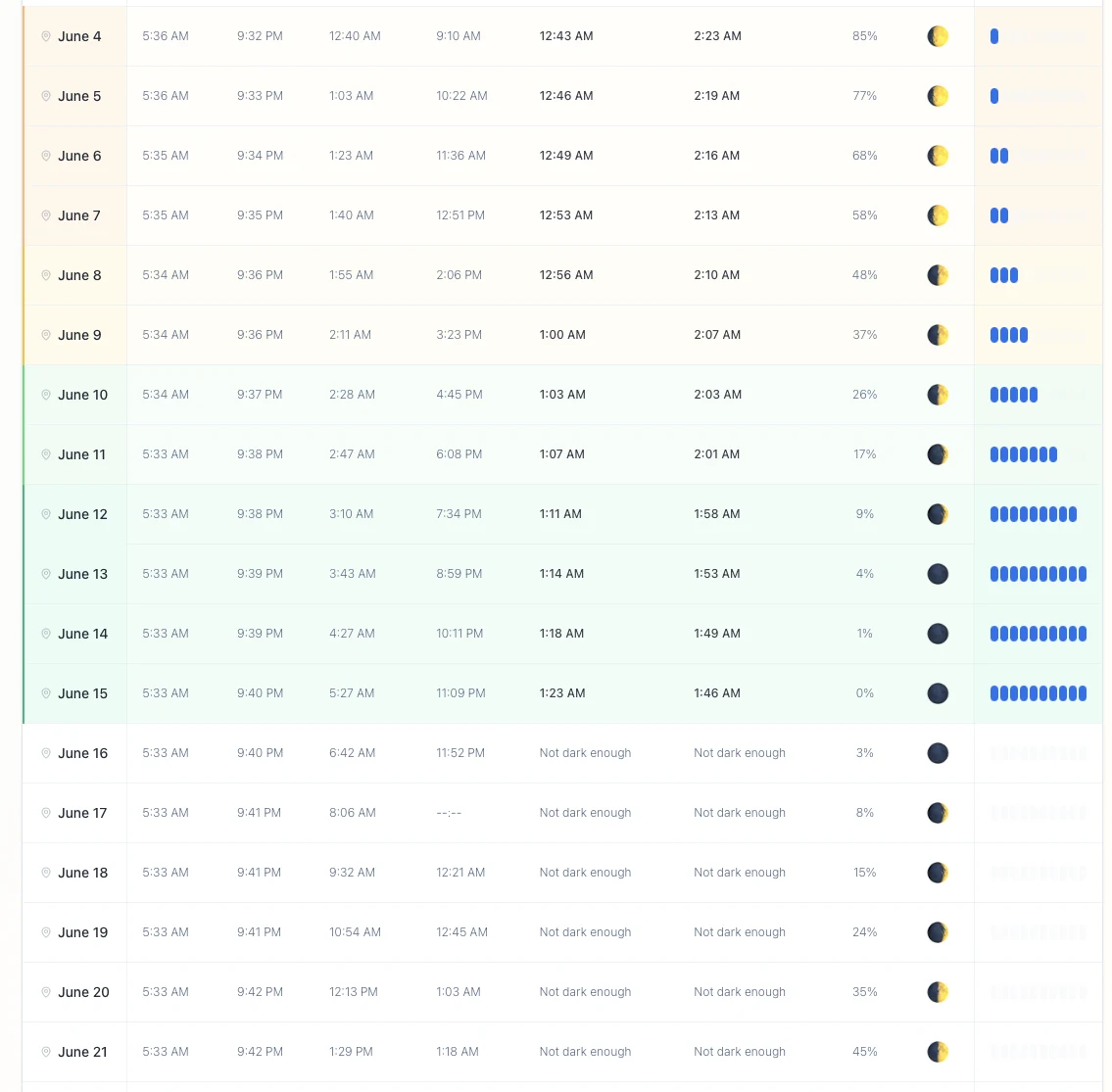
I'll explain why June is short on darkness, what that looks like at a few different latitudes, and how to find the nights actually worth shooting. I pulled the numbers from milkywayplanner.com. The data tells it more directly than a description would.
Why is June short on darkness?
The galactic core needs real darkness to photograph, not just sunset or the blue hour after it. Astronomical darkness starts when the sun is more than 18 degrees below the horizon and the last of the scattered light is gone. That's the only window the core really shows up in.
The trouble with June is the solstice. June 21 is the longest day of the year, so it's also the shortest night and gives you the least astronomical darkness of the season. The week or two on either side all sit near that same annual floor, so most of June is working with the thinnest darkness of the year.
This June the moon makes the back half worse. The new moon is the 15th. By the 21st the moon is back to about 45 percent lit and sits in the sky through the early part of the night, eating the front of a window that's already short.
What June looks like at your latitude
What you actually get depends on where you are. I ran two June nights, the new moon on the 15th and the solstice on the 21st, for three locations on milkywayplanner.com. Usable dark means astronomical darkness with no moon in the sky, which is the only time you can really shoot the core.
| Location | June 15 (new moon) | June 21 (solstice) |
|---|---|---|
| Big Bend, TX (~29 N) | 10:30 PM - 5:18 AM, about 6h45m, moonless | moon up until 1:28 AM, leaving roughly 1:28 - 5:19 AM, under 4 hours |
| Jefferson County, CO (~40 N) | 10:32 PM - 3:32 AM, 5 hours, moonless | moon up until 12:40 AM, leaving roughly 12:40 - 3:32 AM, under 3 hours |
| Glacier NP, MT (~49 N) | 1:23 - 1:46 AM, 23 minutes, moonless | no astronomical darkness at all |
The pattern runs two ways. Read down the table and latitude decides how big your window is at all: Big Bend gets a generous stretch, Colorado a workable one, Glacier almost nothing. Read across and the new moon nearly doubles your time at every latitude, because on the solstice the moon is up and the night is already at its shortest.
The latitude wall
Glacier just sits at the front edge of something that affects anyone shooting from the northern half of the country.
There's a line at about 48.5 degrees north where, for the weeks around the solstice, the sun never reaches 18 degrees below the horizon. Above that line you don't get astronomical darkness in June at all. It doesn't matter how far you drive or how clear the sky is.
The pattern keeps going north:
- 48.5 to 53 N (the northern US border, southern Canada, most of the UK): astronomical twilight all night. No true dark.
- 53 to 61 N: nautical twilight at best.
- Above 61 N: civil twilight straight through. White nights, where it never really gets dark enough to need a headlamp.
If you're north of that line, June isn't really Milky Way season. Your darkness comes back in late July and August, or you travel south to find it. I got into how latitude reshapes the whole year in this post on how latitude changes your Milky Way season.
When should you actually shoot in June?
Aim for the new moon and the nights around it. This June that's roughly the 12th through the 18th, centered on the 15th, before the solstice rather than after. You get moonless skies and a dark stretch that's still a touch longer than it'll be on the 21st. That's the best June offers at any latitude that gets dark at all.
Miss it and you're waiting on the July new moon, the 14th. There's an upside to that one: by mid-July the nights are lengthening again, so you get a dark moon and a longer window at the same time. The core also climbs a little higher and rises a little earlier each week as the season rolls on, so the back half of summer keeps improving.
When your window is short, the planning gets less forgiving, not more. Three usable hours doesn't leave room to find your composition in the dark or wait out a band of cloud. Scout the location in daylight, know your core timing to the minute, and be set up and focused before the dark window opens instead of arriving when it does. You can pull the exact dark window and core position for your own location and date on milkywayplanner.com before you commit a night to it.
June puts the core up high and visible for most of the night. What's in short supply is the dark window around it, and how much of that you get is mostly a function of where you are.