Planning ISS Transits: Moon and Sun Photography
Master the art of capturing International Space Station transits across celestial bodies through strategic long-term planning and precise timing.
The International Space Station moves at 17,500 miles per hour. It circles Earth every 90 minutes. When it passes between your camera and the moon or sun, you get half a second. Maybe a little more.
That's your shot.
ISS transit photography requires a different mindset than most astrophotography. You might spend hours on the Milky Way. An ISS transit happens once. Miss it, and you wait months for another chance at that same spot.
How Transits Work
An ISS transit happens when the station's orbit lines up perfectly with your position and a celestial body. The station appears as a dark shape against the bright moon or sun. The whole thing lasts 0.3 to 1.5 seconds. The station moves fast enough to challenge even experienced photographers.
Solar transits give you higher contrast but need proper filters and safety gear. Lunar transits are easier to expose and safer with standard telephoto lenses. But they demand precise timing since the moon is dimmer than the sun.
The ISS completes about 15.5 orbits daily. Only a fraction create viewable transits from any location. The station's orbital tilt of 51.6 degrees covers most populated areas. But the viewing corridor for any transit is narrow, typically just a few miles wide.
Your Transit Calendar
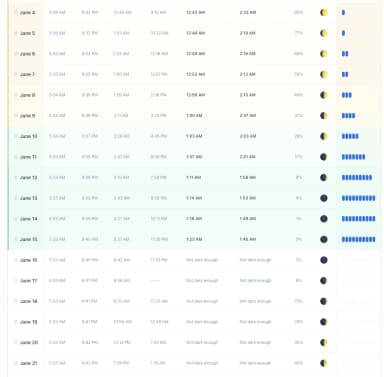
Start planning months ahead. Identify your shooting locations and build a calendar of potential transits through the year. The Milky Way Planner can help you coordinate transit attempts with your broader astrophotography schedule. Think beyond the transit itself. Consider weather patterns, how easy it is to reach in different seasons, and what other photography opportunities compete for your time.
Spring and fall usually offer the most consistent weather in temperate regions. Summer heat creates atmospheric distortion that hurts image quality. Winter conditions might block access to good viewing spots.
Mark primary and backup dates for each promising transit. ISS orbital parameters shift slightly over time. Predictions get less reliable past six months out. But you can spot general patterns and seasonal opportunities to structure your planning.
For lunar transits, think about the moon's phase. A fuller moon gives you a larger, brighter target but might wash out fine details of the ISS structure. A thin crescent creates dramatic contrast but offers a smaller target. You need even greater precision.
Location Scouting
Transit visibility depends entirely on where you stand. Move a few miles north or south of the predicted centerline, and you might miss everything. This makes location scouting critical.
Start with broad transit predictions for your region. Then narrow down to specific viewing corridors. The ideal spot sits within the centerline of the predicted path. This gives you the longest transit duration and best chance of capturing the ISS crossing dead center.
Scout potential locations during daylight. Identify clear sight lines and potential obstacles. Urban areas offer accessible viewing points but may suffer from air pollution that reduces image quality. Rural locations provide cleaner air but might lack convenient access or backup options if weather turns bad.
Consider multiple viewing positions along the predicted path. If clouds block your primary location, you need alternatives within the narrow viewing corridor. Map these backup positions ahead of time. Include driving times and setup requirements for each.
Pay attention to elevation changes along the transit path. Higher elevation usually means clearer atmospheric conditions. But dramatic elevation differences can shift the apparent transit timing and path.
Equipment Setup
ISS transits demand equipment that balances reach, speed, and reliability. A telephoto lens in the 400-600mm range provides enough magnification to show ISS details while maintaining a field of view that accommodates targeting uncertainties. Longer focal lengths increase magnification but make precise aiming harder.
Manual focus set to infinity works for most transit photography. Test this setting with your specific lens beforehand. Some telephoto lenses have infinity focus points that don't align exactly with the hard stop. They need fine adjustment.
Continuous autofocus can work for solar transits where the bright sun provides strong contrast. But manual focus removes the risk of the system hunting at the critical moment. For lunar transits, the lower contrast often defeats autofocus entirely.
Plan your exposure settings ahead of time. Solar transits typically need the same settings you'd use for general solar photography with appropriate filtration. Lunar transits need settings that properly expose the moon's surface while maintaining fast enough shutter speeds to freeze the ISS motion.
Test your complete setup well before the event. Include camera settings, tripod stability, and solar filtration if needed. The brief transit window leaves no time for equipment adjustments or setting changes.
Timing and Execution
Precise timing separates successful captures from near misses. Begin setup at least 30 minutes before the predicted transit time. This allows for final equipment checks, composition refinement, and mental preparation.
Frame your shot to include extra space around the predicted transit path. Slight variations in ISS position or timing can shift the apparent path. The additional framing provides insurance against these small differences.
Start shooting several seconds before the predicted transit begins. Continue for several seconds after. Shoot in burst mode to maximize your chances of capturing the ISS at different positions across the celestial body. The brief duration makes it nearly impossible to react in real time. Rely on continuous shooting to bracket the event.
Monitor ISS position updates in the hours before your planned shoot. Space station orbital adjustments can slightly alter transit predictions. Last-minute updates help refine your timing.
Keep backup power sources ready. Cold weather drains camera batteries quickly. Setup time before the transit may consume significant battery life.
Solar Transit Safety
Solar transit photography requires absolute attention to safety. Never look directly at the sun through your camera's optical viewfinder. Never try to focus without proper solar filtration.
Use only dedicated solar filters designed for photography. Position them securely over the front of your lens. Live view eliminates the need to look through the camera during setup and shooting. But even the camera's sensor needs protection from the sun's concentrated energy.
Install solar filtration before pointing your lens toward the sun. Keep it in place throughout the entire session.
White-light solar filters provide the most neutral color balance for transit photography. Hydrogen-alpha filters create dramatic red imagery but may not show ISS details as clearly.
Plan your shooting position to avoid accidentally pointing your unfiltered lens at the sun during setup or while moving between shots. This matters especially with long telephoto lenses that concentrate significant solar energy.
Weather Backup Planning
Cloud cover represents the primary threat to success. Unlike other astrophotography subjects that might appear on consecutive nights, ISS transits occur at specific times with no rescheduling options.
Monitor weather forecasts beginning five days before your planned shoot. Pay attention to cloud cover predictions rather than general weather conditions. Partly cloudy skies might still allow successful captures if the clouds clear at the right moment.
Develop contingency plans for multiple locations along the transit path. Regional weather patterns often vary significantly over distances of 50-100 miles. This provides options if your primary location faces poor conditions.
Consider the direction of cloud movement relative to your shooting time. Fast-moving clouds might clear just in time. Slow-moving systems may persist throughout the event window.
The brief, unrepeatable nature of ISS transits makes them among the most demanding subjects in astrophotography. If you are looking for a less time-pressured challenge, star trail photography and eclipse photography offer different planning dynamics. Success requires careful planning, precise execution, and often a bit of favorable weather. But when everything aligns—your preparation, the timing, and the conditions—you capture a moment that represents humanity's presence in space frozen against the cosmos beyond.