Milky Way Photography in 2027: How I'd Plan the Year
Photo by Brad Switzer on Unsplash
The calendar tells you which nights work. This is what I'd actually do with them.
In 2027 the galactic core follows the same yearly arc it always does. In the Northern Hemisphere it's a pre-dawn target in spring, up most of the night in early summer, and an evening target by fall. The Southern Hemisphere gets it higher and for longer. The moon and the sky events are the parts that shift from year to year.
2027 has a total solar eclipse on August 2, which by definition falls on a new moon, and the Perseids peak on August 12–13 under a waxing moon. Your exact dates depend on where you stand, so start with the 2027 Milky Way calendar and the free planner.
This post is my plan for the year: which windows I'd build trips around, which events I'd travel for, and the order I'd lock things in. I'm leaving the date table to the calendar grid. It rates Saturday nights for the locations on it, and the planner rates every night for any spot you type in.
Milky Way photography in 2027 at a glance
I pick moon windows before anything else
A good month can still give you a week of gray skies around the full moon, so I choose the moon windows first and fit everything else around them.
Moon phase guideLatitude sets how long your season runs
The farther south you stand, the longer the core season runs, and the core climbs higher until about 29°S, where it passes overhead. If you're far north, you lose weeks around midsummer.
Latitude guideTwo 2027 events that change how I plan trips
The total solar eclipse on August 2 lands on a new moon, and the Perseids peak under a moon between first quarter and full.
See the 2027 eventsIf you want to see which nights the grid already likes for the locations it tracks, the best Saturdays of 2027 are listed on the calendar page.
How the core season runs by hemisphere and latitude
The core season depends on latitude more than the calendar. The farther south you are, the longer the season, and the core climbs higher until about 29°S, where it passes overhead. Above about 48.5°N there are nights around the June solstice with no astronomical darkness at all, from under a week just north of that line to about six weeks at 50°N. Look up your row on the 2027 calendar to see Milky Way season 2027 by location, or enter your coordinates in the planner for nightly ratings.
None of this is specific to 2027. The core keeps the same yearly arc every year, and I go deeper on it in best time to photograph the Milky Way.
Northern Hemisphere
Late in winter or early in spring the core shows up as a low arch in the southeast, a few hours before dawn. Each week it rises a little earlier. By early summer it's up for most of the dark hours, and by autumn it's an evening target sitting low in the southwest that sets soon after the sky gets fully dark. The months on either end of that arc get shorter the farther north you go.
Southern Hemisphere
The galactic center sits at a declination of about −29°, so from the Southern Hemisphere it rides much higher. Near 25°S it passes nearly overhead. At the same distance from the equator, a southern site gets a longer usable season than a northern one, which is why locations like the Atacama, the Namib and Uluru are on our grid.
High latitudes and the summer-twilight problem
North of about 48.5°, the sun never gets 18° below the horizon for a stretch of nights around the June solstice: about 6 nights at 48.6°, 22 at 49° and 41 at 50°. That means no astronomical darkness, and the planner scores those nights 0 no matter where the core or the moon is. Your season splits into a spring stretch and a late-summer stretch with a gap in the middle. I walk through the numbers in Milky Way photography in June by latitude.
Low latitudes
Hawaii, Canary Islands
The core climbs higher here and the season runs longer, and you get full astronomical darkness all summer.
See your 2027 datesMid-north
Most of the US, including the Southwest, and southern Europe
You get the classic arc, pre-dawn in spring, most of the night in early summer and evenings by late summer, with the core low in the south and full astronomical darkness all summer.
See your 2027 datesFar north
UK, northern Europe, much of Canada
North of about 48.5°N there are nights around the June solstice with no astronomical darkness (a few near the line, weeks by 50°N), so your season splits into spring and late summer.
Check your exact spot
How the planner rates a night
A night scores 0 unless the galactic core is above the horizon for at least 15 minutes of astronomical darkness, meaning the sun is more than 18° below the horizon. If it is, the 1–10 score comes from moon illumination: 10 when the moon is 5% lit or less, falling to 0 once it's more than 85% lit. It's sky geometry, and it says nothing about the weather.
A few details matter when you read the grid. Past that 15-minute minimum, how long the dark window lasts doesn't change the rating. It nudges a separate shooting-quality score by half a point at most, and with core altitude and Bortle class added in, that score can sit up to 2 points above or below the rating. The rating also ignores when the moon rises and sets. It reads the illumination percentage and nothing else, so a half-lit moon that sets early and one that's up all night score about the same.
Light pollution, clouds and your local horizon aren't in it either. A very bright moon can still push a night to 0 even when the core is up, so a 0 in midsummer can mean either problem. The full method is in how Milky Way visibility ratings work.
The windows I'd build 2027 trips around
This is the part the grid can't do for you. I plan around a stretch of strong nights near the dark moon, because weather is going to take at least one of them away. Here are the four windows, and the actual dates for each one come from the 2027 grid.
Spring pre-dawn
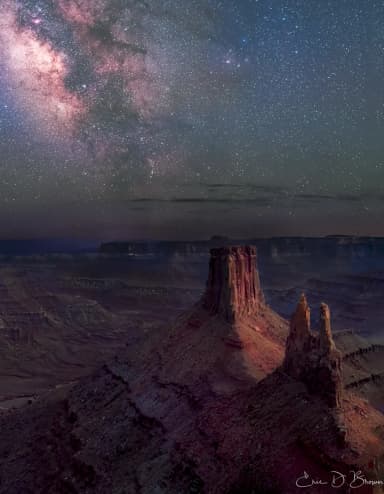
Good for: a low, full arc across the horizon before dawn early in the season. That's my 2027 plan at Moon Overlook.
Watch out for: an early alarm and a short window before morning twilight.
Late spring and early summer
Good for: multi-night trips, with the core up for most of the dark hours.
Watch out for: shorter nights the farther north you go.
Late summer evenings
Good for: shooting right after dark, without a middle-of-the-night alarm.
Watch out for: a shorter window each night as the core sets earlier.
Southern winter
Good for: a core that passes close to overhead and a long season.
Watch out for: long travel, so pick the moon window before you book flights.
Spring pre-dawn runs (Southwest)
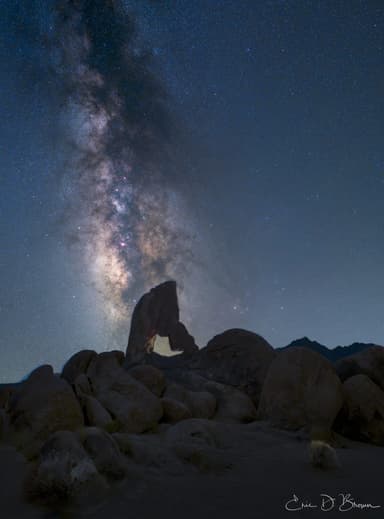
In spring the core is low and only up before dawn. It lies close to the southeastern horizon as a flat arch, and that shape suits panoramas and arch shots with a strong foreground. How to plan the full Milky Way arch shot covers the timing.
This is the window I'm planning to shoot in 2027. I want to set up at Moon Overlook near Hanksville, Utah, for a pre-dawn full Milky Way arc early in the season, while the arc still lies low across the horizon. I haven't picked the nights yet. I'll find the moon windows on the 2027 calendar grid, then confirm the exact nights for Moon Overlook in the planner, the same way I'm suggesting you do it for your spot.
In the planner I'd look at when the core clears the horizon and how much dark time is left before morning twilight starts. A night can rate well on the moon and still give you a short window, because the rating doesn't count how long the window lasts.
Late spring and early summer
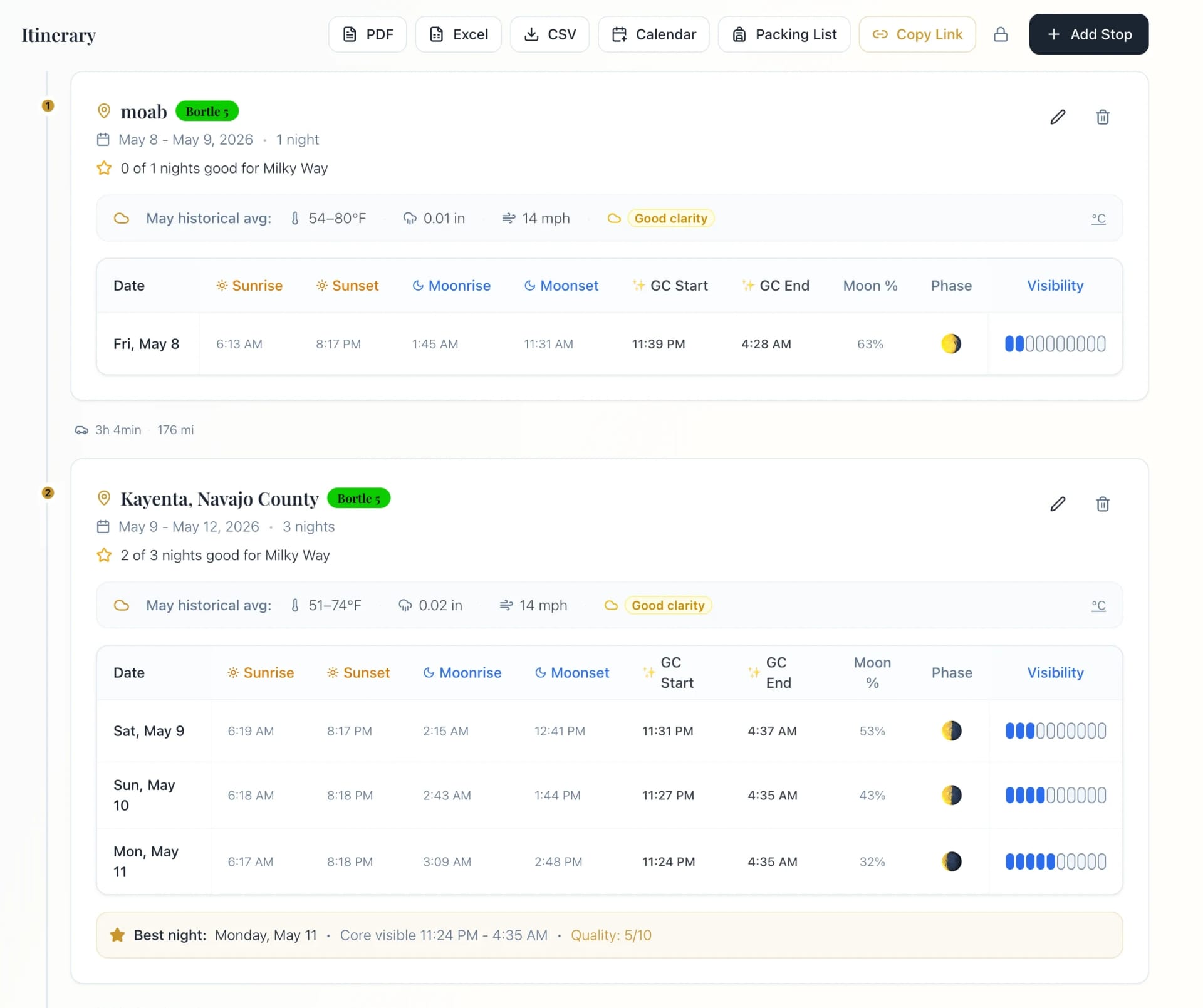
This is where I'd put a longer, multi-stop trip. In May 2026 I planned a 12-day loop: one night in Moab, three nights at Goulding's Lodge near Kayenta, six nights in Farmington for a workshop at the Nightscaper Conference with time in the Bisti/De-Na-Zin Wilderness and the Chaco area, then a night in Jefferson County, Colorado on the way back to Denver. I wrote the planning walkthrough the day before I left. For 2027 I'd reuse that same shape and re-pick the dates from the 2027 grid.
Moon timing matters here too. In my moon phase guide I compare two May 2027 nights at Moab (times are MDT). On the night of May 12–13 the moon is 54% lit and sets at 2:21 a.m., inside the core window. On the night of May 27–28 it's 50% lit and doesn't rise until 1:44 a.m., so the core comes up into a dark sky. The rating sees those two nights as roughly equal because it only reads illumination. I check moonrise and moonset myself before I commit to a night.
Moab · May 12–13, 2027
54% lit
Moon sets at 2:21 a.m., inside the core window.
Moab · May 27–28, 2027
50% lit
Moon doesn't rise until 1:44 a.m., so the core comes up into a dark sky.
Late summer and early fall evenings
By late summer the core is already up when it gets dark. There's no 2 a.m. alarm, which makes these good nights for short trips and for anyone who has to work the next morning. The tradeoff is a shorter window each night, since the core sets earlier every week.
This window also overlaps the two big 2027 events, the August 2 total solar eclipse and the Perseids, with the moon caveat covered below.
Southern Hemisphere winter
If you're heading south, the austral winter is the long, high season. The Atacama, the Namib and Uluru are all on our grid, and the core passes close to overhead from that latitude. I don't have a southern trip to point to, so I'll keep this short. If you've never shot from that latitude, compare a southern row with a northern one on the grid and you'll see how much longer the season runs.
Plan a multi-stop trip in one place
Premium adds the Trip Planner, saved locations, the Moon Planner with moonrise and moonset times and direction, phase and supermoons, and PDF, Excel and CSV exports with add-to-calendar.
2027 eclipses and meteor showers
Per the International Meteor Organization's 2027 calendar, the Eta Aquariids peak (May 6, UT) and the Southern Delta Aquariids (July 31) have favorable moonlight. The Perseids peak August 13 UT with the moon between first quarter and full, so the moon-free window is short. The Lyrids, Orionids and Geminids are all moon-troubled in 2027.
I sort events into two groups. Some are worth building a trip around, and some are only worth a look if I'm already out. For Milky Way work, a meteor shower under a bright moon goes in the second group, because the moonlight that washes out faint meteors washes out the core too.
Worth planning around
Feb 6: Annular solar eclipse
Peak: Greatest eclipse 16:00:47 TD, central duration 7m51s. The annular path crosses Chile, Argentina and the Atlantic.
Moon: a solar eclipse happens at new moon.
Verdict: pair it with dark nights in South America and check core times there in the planner.
May 6: Eta Aquariids
Peak: around 09h UT, ZHR 50 (variable, 40–80+). Pre-dawn shower, most useful from south of about 40°N.
Moon: IMO says it "can be well observed without moonlight interference."
Verdict: worth a pre-dawn session with the core in the frame.
Jul 31: Southern Delta Aquariids
Peak: ZHR 25, better toward southern latitudes.
Moon: IMO lists "no moonlight interference" around the maximum.
Verdict: a quiet bonus on a summer core night.
Aug 2: Total solar eclipse
Peak: Greatest eclipse 10:07:49 TD, central duration 6m23s. Totality crosses Morocco, Spain, Algeria, Libya, Egypt, Saudi Arabia, Yemen and Somalia.
Moon: new moon by definition.
Verdict: the nights around it are moon-dark too.
Only worth a look if I'm already out
Aug 12–13: Perseids
Peak: August 13, 08–10h UT, ZHR 110+.
Moon: IMO says the moon "lies midway between first quarter and full on August 12 and 13, so the moon-free period will be quite short."
Verdict: shoot it if you're already out, and plan for a short dark window.
Apr 23: Lyrids
Peak: 01:40 UT, ZHR 18.
Moon: "just three days after the Full Moon," and IMO says the Lyrid maximum "has the worst conditions."
Verdict: moon-troubled this year, so skip it for Milky Way.
Oct 22: Orionids
Peak: ZHR 20.
Moon: a bright waning moon lights the sky while the radiant is up.
Verdict: the moon is up with the radiant, so skip it.
Dec 14: Geminids
Peak: around 20h UT, ZHR 150.
Moon: full, and IMO says it "severely disturbs" the shower.
Verdict: the strongest shower in this list, and the full moon washes it out.
Feb 20, Jul 18 and Aug 17: Penumbral lunar eclipses
Moon: full moon on each date.
Verdict: subtle to see, and the full moon washes out the core.
Sources: NASA's solar and lunar eclipse tables (Eclipse Predictions by Fred Espenak, NASA's GSFC) and the International Meteor Organization's 2027 calendar. Times are in UT or TD as the sources give them, so your local date can differ by a day.
August 2
A solar eclipse only happens at new moon, so the nights around the August 2 totality are moon-dark too. If you're traveling for it, check the core times for your spot in the planner before you book.
I'm keeping the eclipse cards to what NASA publishes. For eclipse prep in general, my eclipse photography planning post covers the method. It doesn't cover 2027 specifically, so use it alongside the NASA tables.
Two more showers sit outside the main season. IMO lists favorable moonlight for the Quadrantids and the Ursids. The Quadrantids peak shortly after 03h UT on January 4, shortly before new moon, and the Ursids peak around 04h UT on December 23. Both fall outside the core season in the north, so I'd treat them as winter bonuses on nights I'm already out.
How I'd plan the year, in order
This is the order I'd commit in, and each step narrows the next one: the moon narrows the weeks, the foreground narrows the location, and the weather comes last because it's the only part I can't plan months out.
- Set your pin and read your row. Open the 2027 calendar, then put your exact spot in the free planner. A spot forty miles away can have a different horizon, and its core hours can shift by a few minutes.
- Pick moon windows first. Lodging comes later. On a Moab trip I planned earlier this year, lodging nearly set the dates, and I'd have paid for nights under a bright moon if I'd let it.
- Check core direction against your foreground. In my Moab planning example, Mesa Arch, Dead Horse Point and Fisher Towers each face a different way, so the core's position decides which one works on a given night.
- String nights into a trip. The Trip Planner (Premium) puts every stop, date and night's data in one view. You can see my Southwest trip plan below as an example.
- Push the nights to your calendar app, then check weather a week out and again the day before. Exports and add-to-calendar are Premium. For the forecast I use Clear Outside, which shows cloud cover by layer along with visibility, fog, wind, humidity and dew point. If you want seeing and transparency, Astrospheric and Meteoblue show both.
Before you book anything, put your exact spot into the free planner and check your 2027 nights there, no account needed.