Plan a Milky Way Photography Trip: Checklist and Dark-Sky Logistics
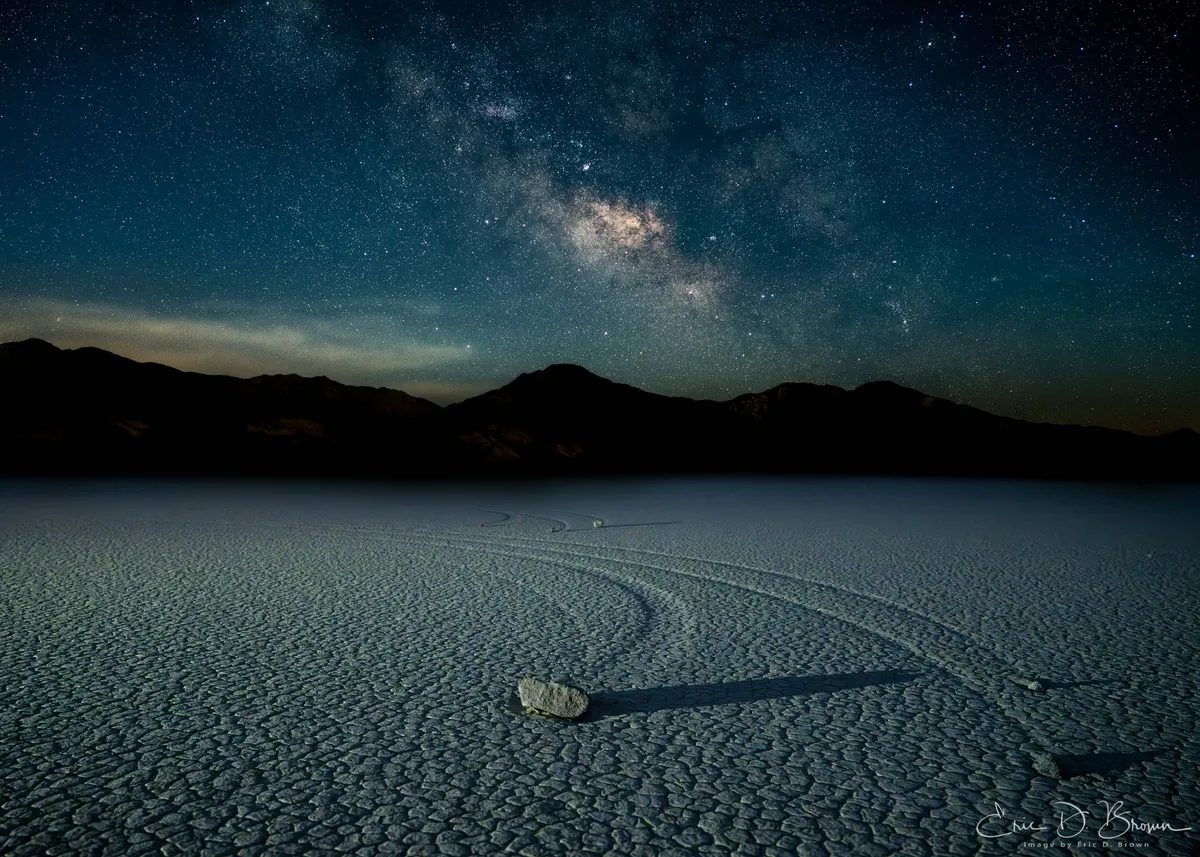
Photo by Eric D. Brown
The order I plan a Milky Way photography trip in: dates around the new moon, the core's timing at the spot I'll shoot, a foreground that faces it, and only then lodging, drives and a weather backup.
I get asked how to plan a Milky Way photography trip more often than how to set ISO. A good night under the core is half astronomy and half logistics: where you sleep, how far you drive at 2am, and whether you picked a weekend the moon already ruined. This page is the checklist I actually use before I book anything.
Dates come first, picked around the new moon. Then I check that the galactic core is actually up while the sky is fully dark at the spot I want to shoot, and I find a foreground that faces the core from there. Only after that do I book a place to sleep, work out the drive, and pick a backup spot in case the clouds roll in. Gear and settings come later.
I've wasted PTO on bright moons and beautiful arches that faced the wrong way. The checklist below is what I run so that doesn't happen again. For a worked three-day example, see How I plan a 3-day astrophotography trip (Moab). For stacking nights across a region, the multi-night trip planning lesson is the companion.
Pick your dates around the new moon
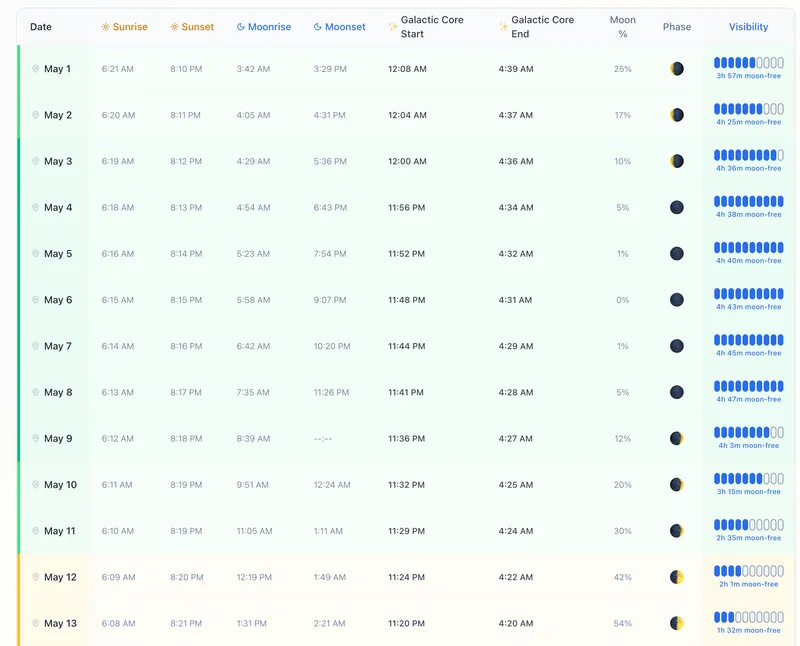
Moon first, always. A near-full moon washes the Milky Way into gray mush no matter how dark the sky is. For a Milky Way road trip I plan around the new moon: a few nights on either side of it, when there's little enough moonlight that the core keeps its contrast. For phase-and-illumination detail, see the moon phase guide for Milky Way photography.
Pull the dark nights for your target month from the planner, and treat those nights as your only candidates. If your PTO only covers one weekend, make sure that weekend falls inside the dark window. Hotels and campsites fill up around school holidays, so I pick the dates first and book early.
This is the first thing I use milkywayplanner.com for. Open the free calendar for your destination, scan for nights with strong visibility ratings, and those become your candidate dates. Everything else fits around that band. If you're comparing a lot of locations across a whole year, the 2027 Milky Way calendar shows the best Saturdays for each one, which is a quick scan before you zoom into a single spot.
Check when the core is up where you'll shoot
Knowing it's Milky Way season gets you to the right months. To pick the nights, you need to know when the galactic core rises at your latitude, how high it gets during the dark hours, and roughly which compass direction to face. A southwest trip in peak season can still fail if the core is below the horizon during the only hours you can stay awake, or if your favorite arch faces northwest while the core is climbing in the southeast.
I check core rise, set, and altitude for each candidate night at the actual coordinates, not the nearest big city. A few degrees of latitude changes how high the core climbs and how long the usable window lasts. Short summer nights at higher latitudes can compress astronomical darkness even when star charts still show Sagittarius "up." Trust the location calendar over a country-wide season slogan. For the evergreen season rule, see the best time to photograph the Milky Way hub.
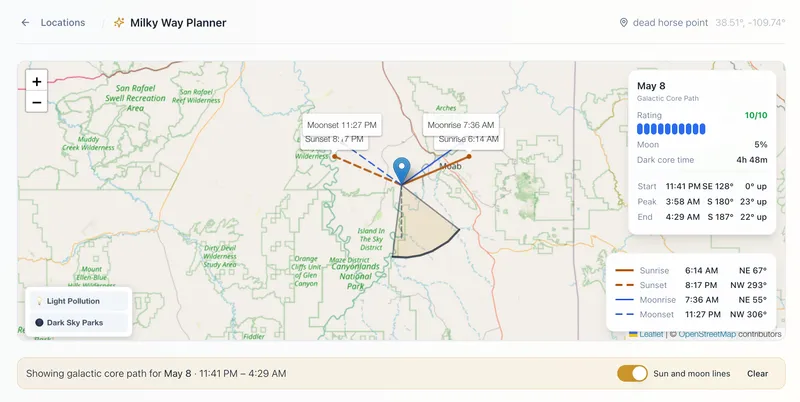
Spend fifteen minutes on this before you book. It changes which locations make the shortlist and which nights you assign to which foreground. Once the dates are locked, PhotoPills (or something like it) helps you see the arc against a specific landmark. I use the planner to decide whether a night is worth the drive, and the AR view to check that the rock and the sky actually line up.
Pick sites and foregrounds, then check access
A dark spot on a light pollution map is only the start. You want skies dark enough for the core, a foreground that works with the core's direction on those nights, and access you can live with at midnight. Certified International Dark Sky Parks are a strong starting list. So are spots a short drive from town if the town glow stays behind you and out of the frame.
For each shortlisted site I ask three questions:
- How dark is the sky (a light pollution map gets you close)?
- Which way does the foreground face on my target nights?
- Can I get there at night without a sketchy road or a locked gate?
A location that looks perfect in daytime photos can hide a lit parking lot, a cell tower, or a dirt road that eats low-clearance cars after rain.
If you can daytime scout, do it. Walk the sightlines. Note parking, restrooms, and whether other photographers already own the best pad. For longer itineraries across Utah, Arizona, and New Mexico I keep a priority list rather than a rigid night-by-night script: best weather nights go to the highest-priority compositions. That approach is how I built the 12-day Southwest photography trip and how I still plan multi-stop Milky Way road trips.
The logistics checklist I use
Once the dates and spots are settled, the trip succeeds or fails on boring details.
Lodging. Stay close to the primary shoot. A 30-minute drive each way becomes an hour of tired driving every night. Closer lodging improves the whole trip more than a fancier hotel farther away.
Sleep. You will be up most of the night. Shift your schedule a day early if you can. Pack an eye mask or use blackout curtains. If a night clouds over, sleep. That rest keeps you sharp for the clear ones.
Fuel, food, water. Stock before you leave the last real town. Many dark sites are nowhere near a grocery store at 1am. Coffee and water matter as much as spare batteries.
Vehicle. Tire pressure, spare, jack, and a clear plan for rough roads. Know where the last reliable gas is, and if the best pad sits at the end of a washboard track, your car (or a friend's) has to survive it.
Safety. Tell someone where you are going and when you expect back. Carry a first aid kit and a way to call for help if cell service dies.
Weather buffer. Historical patterns help weeks out. Real forecasts matter about a week before and again the day before. I use Clear Outside (or similar) for cloud cover and transparency. If one night looks worse, I move priority compositions to the better nights. If all nights look bad, I still go, because forecasts miss and clearing storms sometimes deliver the best air of the trip.
Field kit. A dimmable headlamp you keep off while the shutter is open, spare batteries in a warm pocket, intervalometer if you stack, printed or offline notes for core timing, and a packing list you actually check. When I build a multi-stop plan I keep a packing baseline in the trip tools on the site. The camera gear I carry is on the resources page.
A three-night plan
For a three-night trip, center the nights on the dark-moon window. Assign night one to a reliable, easy-access site so you shake down gear and sleep schedule. Assign the best forecast night to the highest-priority foreground. Keep one night flexible for a revisit or a backup spot two hours away if weather forces a move. Check core timing for each night and each spot so you know when to arrive, when to shoot the main frame, and when to experiment.
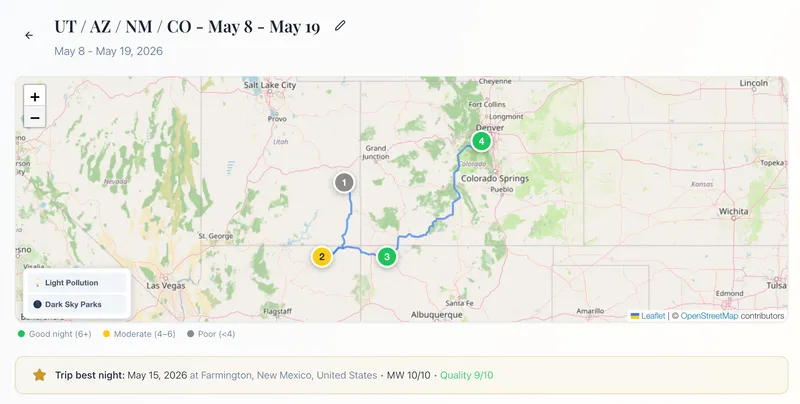
That is the same sequence in the Moab example: moon window, core arc, foreground match, then logistics. When the trip grows to many nights and many stops, I keep locations, dates, and quality scores in one trip view on the site instead of a notes app and three browser tabs. The multi-night lesson walks through priority lists and weather strategy in more depth. The 12-day Southwest walkthrough shows what a real multi-stop plan looks like in the tool.
None of this guarantees clear skies. It gets you to the right place on a night that could work, facing a foreground that works, with enough sleep and fuel to stay until the core is where you need it.
Quick answers
How do I plan a Milky Way photography trip? Pick dates around the new moon first. Then check that the galactic core is up while the sky is fully dark at the spot you'll shoot, and find a foreground that faces it. Book lodging, plan the drive and pick a backup spot after that. A free location calendar shows which nights are worth it before you spend money.
What logistics matter beyond dark skies and a new moon? Lodging close to the shoot, a sleep schedule, fuel and water, a vehicle that can handle the road, someone who knows where you are, and a backup spot for bad weather.
How do I pick nights on a multi-stop trip? Center nights on the dark-moon window, put the best forecast night on the highest-priority foreground, keep one night flexible for a backup spot, and check core timing per stop rather than once for the whole region.
What should I check before I leave? Dates and spots that still rate well, printed or offline core timing, headlamp and spare batteries, packing list, and a plan for rough roads and no cell service.
How does a trip planner help? The Trip Planner keeps several locations, dates, and ratings in one view so you are not rebuilding the plan from tabs and screenshots, which is useful when the route or the group grows.